 FiligranaPT.pt
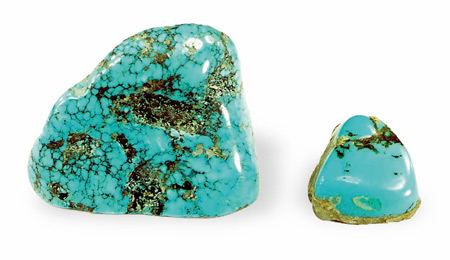
Turquoise
Turquoise is a blue, blue-green, or gray-green opaque gemstone that takes its name from the Turkish trade route these stones traveled to reach Europe in ancient times.
Turquoise has the oldest documented history of all gemstones.
Turquoise was first used in Mesopotamia. Beads have been found that are 5,000 years old.
Turquoise beads have been found in Egypt that date back to 4000 BC.
Throughout history, turquoise has been prized for its talismanic properties.
The ancient Egyptians carved it into animal figures that they wore as symbols of their gods.
During the Middle Ages, turquoise was prized for its supposed ability to prevent falls from horses and to protect the wearer from poison.
In the seventeenth century, this gemstone was worn almost exclusively by men.
The Persians said ".... to avoid evil and gain good fortune, one must see the reflection of the new moon either on the face of a friend, or on a copy of the Koran, or on turquoise..." This puts turquoise in line with religion and friendship, it is a very powerful stone indeed.
The Native Americans held this stone in high regard. The Zuni considered it sacred, carving fetishes and talismans in the shape of animals, insects, and other living creatures. Navajo legends tell of turquoise baskets filled with treasure. The Apache also held turquoise in high regard. It was believed to help a hunter aim more accurately. The use of turquoise by Native Americans began about 1,000 years ago.
Turquoise was the first gemstone mined by man. It was also the first to be imitated!
The porous nature of turquoise allows it to be dyed and impregnated with waxes and polymers. Powdered turquoise is often reconstituted with other ingredients and sold as gemstone turquoise.
Turquoise Care: Warm soapy water.
Back to list