 FiligranaPT.pt

PORTUGAL FILIGREE Certificate
Filigree, the production of traditional handmade jewelry, has a long history in Portugal. Filigree production is concentrated in two areas in the north of Portugal - Gondomar and Póvoa de Lanhoso. These two municipalities have united with the aim of enhancing the value of the filigree technique characteristic of both territories, protecting its producers and protecting this unique handcraft from industrial imitations that mislead consumers and discredit this art.
Portuguese filigree - handmade. The production process includes the following stages, most of which are exclusively manual: drawing, casting, obtaining gold or silver thread, twisting the thread, creating the frame of the future decoration, filling the product, welding, molding the product, finishing (bleaching, cleaning and drying) .
In accordance with the legal framework for jewelers and assay offices, approved by Law 98/2015 of August 18, 2015, products made of precious metals such as gold and silver must be assayed in order to guarantee the consumer the quality and authenticity of the metals/alloys used, which, of course, is a prerequisite for the products to be awarded the "Filigrana de Portugal" certificate.
In addition, the product must have a punch (stamp) with a certification mark applied to it by the jeweler himself (in a place chosen by him and in a size that each workshop considers optimal for each product on which it will be applied), which identifies the product as " Filigrana de Portugal", certified traditional handcraft.
The certification aims to preserve the handcrafted quality of Portuguese jewelry. The technical features that define the production process, mainly manual, using traditional techniques and tools, are described in detail in the Specification - a regulatory document regulating this standard.
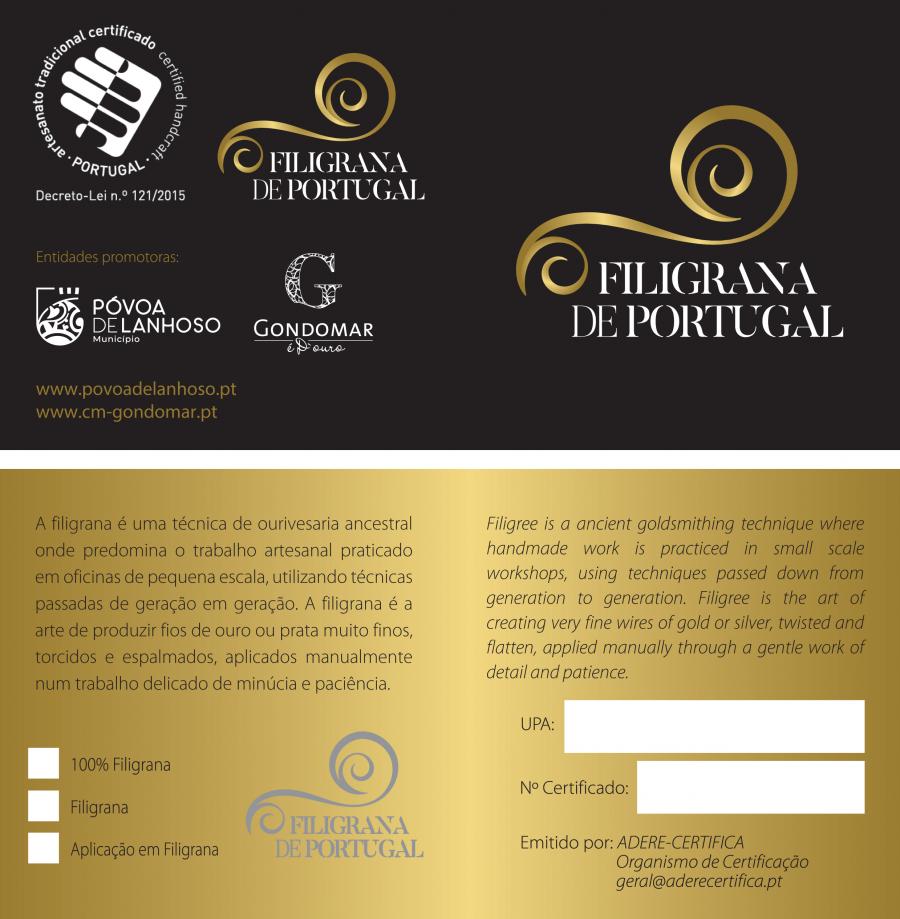
Each craft production received a punch and labels to place on each certified product. The mark is placed directly on the product. The stamp and label as a "seal of guarantee" confirm to the consumer that this is a unique product, handmade in Portugal.
Starting on the afternoon of July 12, 2018, 21 innovative craft production companies were able to display the Filigrana de Portugal certification mark on their products.
The FILIGRANA DE PORTUGAL certification allows consumers to be confident that they are dealing with a unique handmade piece of jewelry, with specificity and distinctive characteristics that make it different from other filigree produced elsewhere in the world, and associated with an important and millennial social cultural heritage.
The Filigree of Portugal certification process excludes any products whose filigree is made using the injection method, which is so common on the market now and is the reason for the devaluation of the term “filigree”, confusing consumers. and hits filigree jewelers, who create jewelry through a complex and labor-intensive hand-made process compared to mass-produced industrial items.
The technical characteristics that define artisanal production are described in the Caderno de Especificações, the normative document governing this process. In addition to technologies, most of which are indigenous and predominantly manual, tools and instruments are also listed, some of which have undergone mechanical improvement over time, which in no way detracts from the artisanal nature of this craft. In addition, the specifications allow for innovation in products, combining filigree techniques with new forms of production and design, as long as the originality and authenticity of the product is preserved.
The purpose of the Filigrana de Portugal certification is to provide the consumer with a new guarantee of quality.
Portuguese filigree - handmade. The production process includes the following stages, most of which are exclusively manual: drawing, casting, obtaining gold or silver thread, twisting the thread, creating the frame of the future decoration, filling the product, welding, molding the product, finishing (bleaching, cleaning and drying) .
In accordance with the legal framework for jewelers and assay offices, approved by Law 98/2015 of August 18, 2015, products made of precious metals such as gold and silver must be assayed in order to guarantee the consumer the quality and authenticity of the metals/alloys used, which, of course, is a prerequisite for the products to be awarded the "Filigrana de Portugal" certificate.
In addition, the product must have a punch (stamp) with a certification mark applied to it by the jeweler himself (in a place chosen by him and in a size that each workshop considers optimal for each product on which it will be applied), which identifies the product as " Filigrana de Portugal", certified traditional handcraft.
The certification aims to preserve the handcrafted quality of Portuguese jewelry. The technical features that define the production process, mainly manual, using traditional techniques and tools, are described in detail in the Specification - a regulatory document regulating this standard.
The "Filigrana de Portugal" certificate is issued by Aderecertifica, an organization accredited by the Portuguese Institute of Accreditation, and meets all the requirements of the National Certification System for Traditional Crafts.
Each craft production received a punch and labels to place on each certified product. The mark is placed directly on the product. The stamp and label as a "seal of guarantee" confirm to the consumer that this is a unique product, handmade in Portugal.
Starting on the afternoon of July 12, 2018, 21 innovative craft production companies were able to display the Filigrana de Portugal certification mark on their products.
The FILIGRANA DE PORTUGAL certification allows consumers to be confident that they are dealing with a unique handmade piece of jewelry, with specificity and distinctive characteristics that make it different from other filigree produced elsewhere in the world, and associated with an important and millennial social cultural heritage.
The Filigree of Portugal certification process excludes any products whose filigree is made using the injection method, which is so common on the market now and is the reason for the devaluation of the term “filigree”, confusing consumers. and hits filigree jewelers, who create jewelry through a complex and labor-intensive hand-made process compared to mass-produced industrial items.
The technical characteristics that define artisanal production are described in the Caderno de Especificações, the normative document governing this process. In addition to technologies, most of which are indigenous and predominantly manual, tools and instruments are also listed, some of which have undergone mechanical improvement over time, which in no way detracts from the artisanal nature of this craft. In addition, the specifications allow for innovation in products, combining filigree techniques with new forms of production and design, as long as the originality and authenticity of the product is preserved.
The purpose of the Filigrana de Portugal certification is to provide the consumer with a new guarantee of quality.
Back to list