 FiligranaPT.pt
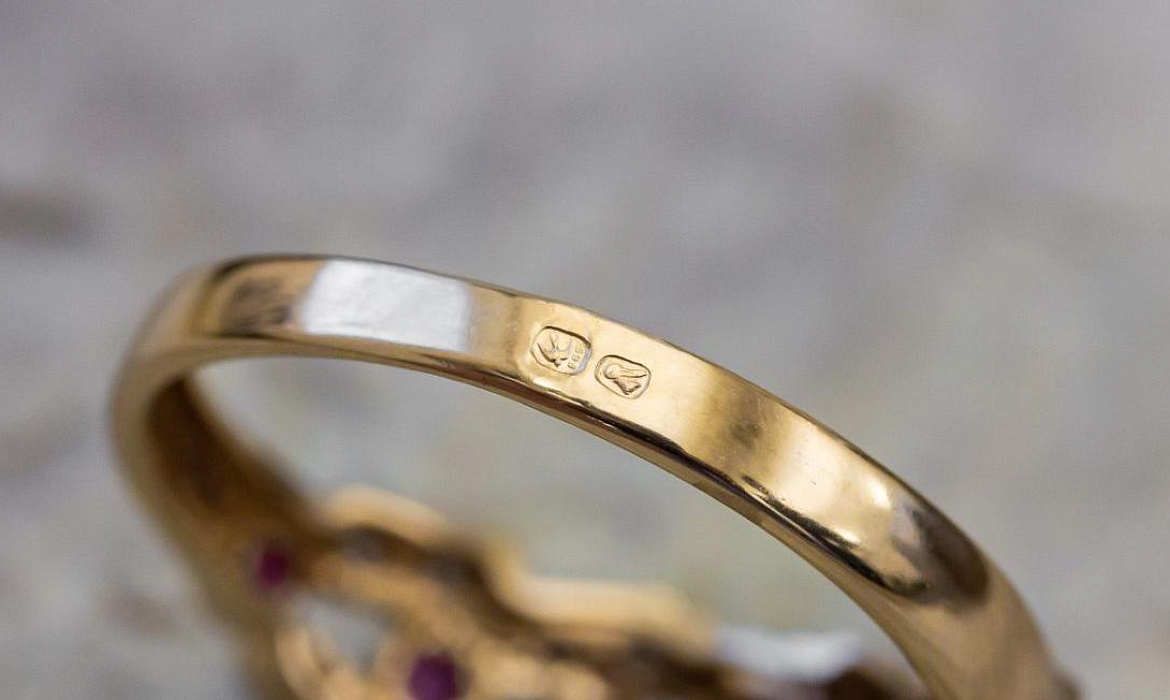
How to check the hallmark on a product made of precious metals
To confirm the quality of the alloys used, there is a control system, which consists of applying a stamp (punch) to the products by the Portuguese Assay Office Contrastaria (an organization authorized at the national level to check and guarantee the metal content of alloys).
All precious metals in Portugal go through Contrastaria, where they are stamped with a stamp. Control and marking of products made of precious metals is the oldest form of consumer protection.
The presence of an hallmark for products made of precious metals is a prerequisite for the sale of these products.
A product made of precious metals must have 2 hallmarks. The Contrastaria mark, which is applied in accordance with the analysis carried out, indicates the type and quality of the metal. The second mark is placed by the manufacturer of the product. In some cases there may be a third and fourth mark. If the product consists of different metals, then a mark is placed for each metal.
In 2021, Contrastaria introduced new hallmarks.
The new hallmarks of the Assay Office came into force on January 1, 2021.
The symbol of the golden brand changed to a ram's head.
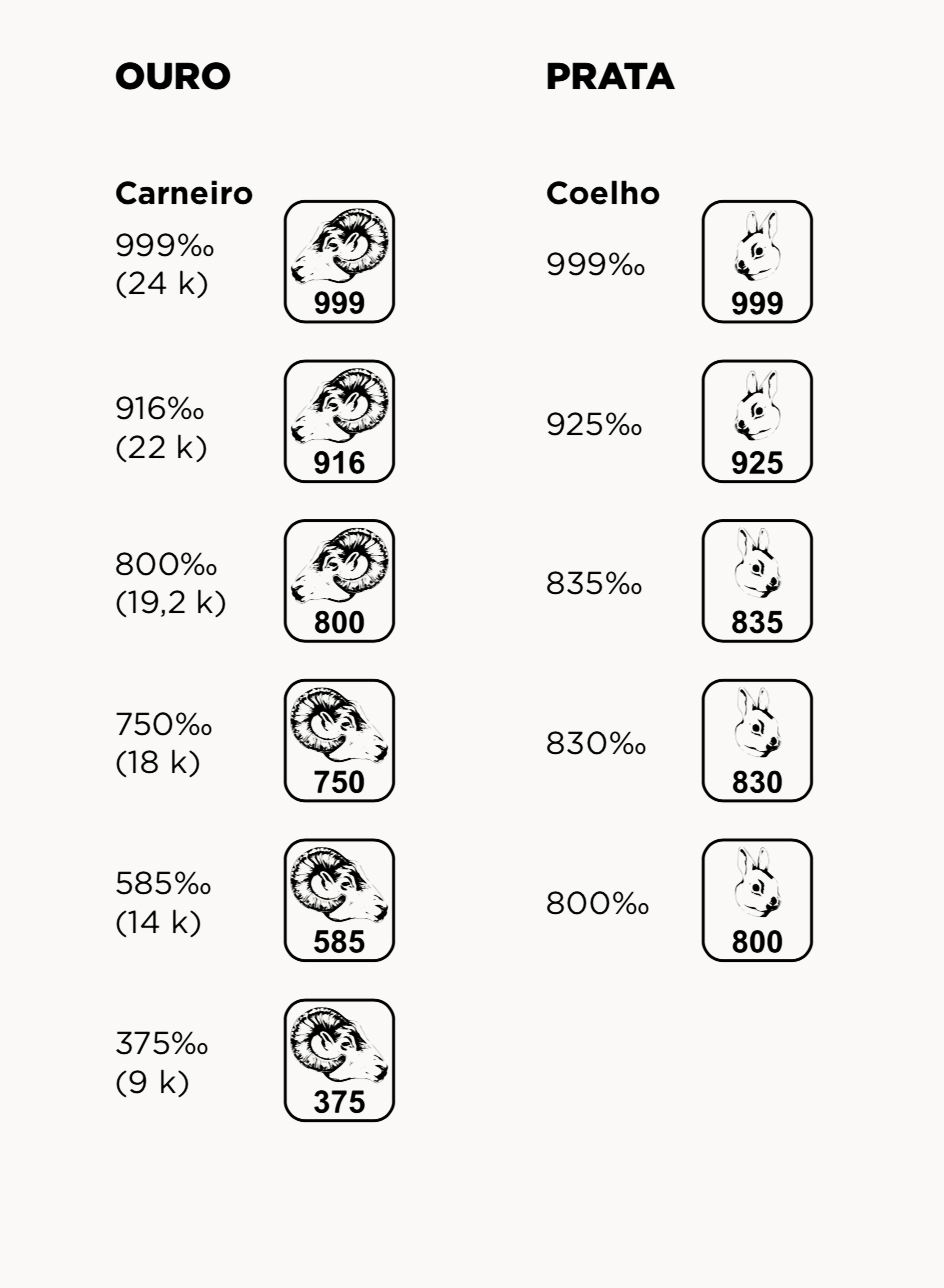
Download a document with a decoding of the mark on products made of precious metals
Portuguese gold has a purity of 19.2K (karats). It is 800 sterling, which means the item is made from an alloy of 80% gold and 20% other materials (usually silver and copper). From a jewelry point of view, Portuguese gold is the best in Europe. It is possible to manufacture products from 22K, but such products are rare in Europe.
At the end of the 19th century, 18 karat gold (750%) and 14 karat gold (585%) were allowed to be used, particularly for watch cases, glasses and bands.
At the end of the 20th century, to meet the needs of the export market, the Assay Office allowed the export of 18-karat gold (750 hallmarks), 14-karat gold (585 hallmarks) and 9-karat gold (375 hallmarks).
After joining the European Union, gold of these grades is now sold in Portugal.
The minimum quality of different carats is established by national and European legislation. Before entering the retail chain, the manufacturer must submit his products to the Assay Office for inspection and hallmarking.
Check if your product has a mark and what symbol it has.
This small mark, which can be viewed through a magnifying glass, has various symbols and numbers. If it is difficult to see the mark, then you can seek help from any jewelry store or the Assay Office. They have a magnifying glass and tables with symbols available.
All precious metals in Portugal go through Contrastaria, where they are stamped with a stamp. Control and marking of products made of precious metals is the oldest form of consumer protection.
The presence of an hallmark for products made of precious metals is a prerequisite for the sale of these products.
A product made of precious metals must have 2 hallmarks. The Contrastaria mark, which is applied in accordance with the analysis carried out, indicates the type and quality of the metal. The second mark is placed by the manufacturer of the product. In some cases there may be a third and fourth mark. If the product consists of different metals, then a mark is placed for each metal.
In 2021, Contrastaria introduced new hallmarks.
The new hallmarks of the Assay Office came into force on January 1, 2021.
The symbol of the golden brand changed to a ram's head.
The left-facing rabbit head and the 925 hallmark are consistent with 925 sterling silver alloy material and are manufactured from 2021 onwards.
If your gold piece is stamped with a stag and 800, it is an 800 permillage gold alloy (19.2 ct) and was made between 1985 and 2020.
The white gold hallmark features an ant, corresponds to 800 ppm (19.2 ct) gold alloy material, and was made between 1938 and 1984. In 1985, the special hallmark for marking white gold ceased to exist.
If your gold piece is stamped with a stag and 800, it is an 800 permillage gold alloy (19.2 ct) and was made between 1985 and 2020.
The white gold hallmark features an ant, corresponds to 800 ppm (19.2 ct) gold alloy material, and was made between 1938 and 1984. In 1985, the special hallmark for marking white gold ceased to exist.
Download a document with a decoding of the mark on products made of precious metals
Portuguese gold has a purity of 19.2K (karats). It is 800 sterling, which means the item is made from an alloy of 80% gold and 20% other materials (usually silver and copper). From a jewelry point of view, Portuguese gold is the best in Europe. It is possible to manufacture products from 22K, but such products are rare in Europe.
At the end of the 19th century, 18 karat gold (750%) and 14 karat gold (585%) were allowed to be used, particularly for watch cases, glasses and bands.
At the end of the 20th century, to meet the needs of the export market, the Assay Office allowed the export of 18-karat gold (750 hallmarks), 14-karat gold (585 hallmarks) and 9-karat gold (375 hallmarks).
After joining the European Union, gold of these grades is now sold in Portugal.
The minimum quality of different carats is established by national and European legislation. Before entering the retail chain, the manufacturer must submit his products to the Assay Office for inspection and hallmarking.
Check if your product has a mark and what symbol it has.
This small mark, which can be viewed through a magnifying glass, has various symbols and numbers. If it is difficult to see the mark, then you can seek help from any jewelry store or the Assay Office. They have a magnifying glass and tables with symbols available.
Only marked products containing precious metals may be sold to the public.
Exempt from marking:
If the product consists of silver and gold or silver and platinum, products with a total weight of 0.5 g or less are exempt from marking.
Exempt from marking:
- gold and platinum products with a total weight of 0.5 g or less.
- silver products with a total weight of 2 g or less.
If the product consists of silver and gold or silver and platinum, products with a total weight of 0.5 g or less are exempt from marking.
Back to list