 FiligranaPT.pt
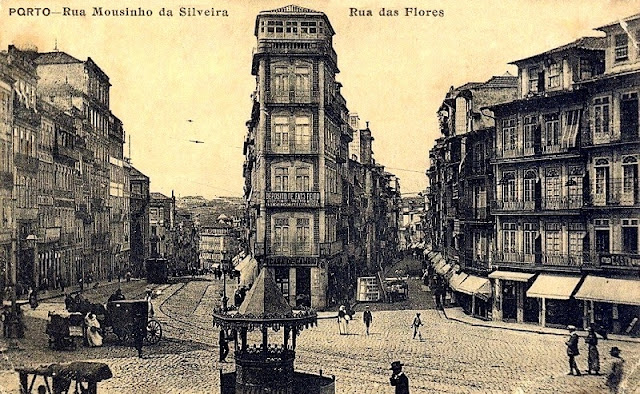
A little over 500 years ago, a new shopping street was built in Porto, named Rua de Santa Catarina das Flores. The street connected the bustling Largo de São Domingos with the Porta del Carros. The street was laid out among gardens and flowerbeds, hence the name "street of flowers."
Rua das Flores, one of the city's widest and straightest streets, served to improve trade with neighboring towns. The street was paved in 1542.
Since the land on which Rua das Flores was built belonged to the Cathedral Chapter and the bishop, it was decided that buildings erected there should bear a plaque clearly indicating the land's owner. Thus, the Cathedral Chapter chose to mark its buildings with figures of São Miguel, while Bishop D. Pedro da Costa chose the heraldic symbol of the wheel of Santa Catarina.
Today, these symbols can be found on some buildings.
The opening of Rua das Flores coincided with the end of Porto's privilege, which limited the nobility to city limits. The street became home to noble families, some of whom still survive today.
Rua das Flores was home to the city's most luxurious shops.
The south side of the street was traditionally home to knitwear merchants, tea and coffee shops, and hardware stores.
Jewelers settled on the north side of the street. In the 19th century, the heyday of the jewelry industry, according to various sources, about 40 jewelers (goldsmiths and silversmiths) settled on Rua das Flores.
Because of this number of jewelry workshops and shops, people nicknamed the street Rua das Ourivesarias (Jewelers' Street) or Golden Street.
The 2008 global financial crisis and subsequent pandemic plunged Jewelers' Street into decline. But now the street is gradually regaining its appeal.
In the fall of 2025, a unique center of Portuguese culture opened on Rua das Flores, in buildings 66 to 70. Several renowned Portuguese brands opened their shops and workshops here.
One of these buildings is entirely dedicated to jewelry and filigree. It evokes an Alice in Wonderland atmosphere. Workshops are open here, where curious visitors can observe jewelers at work.
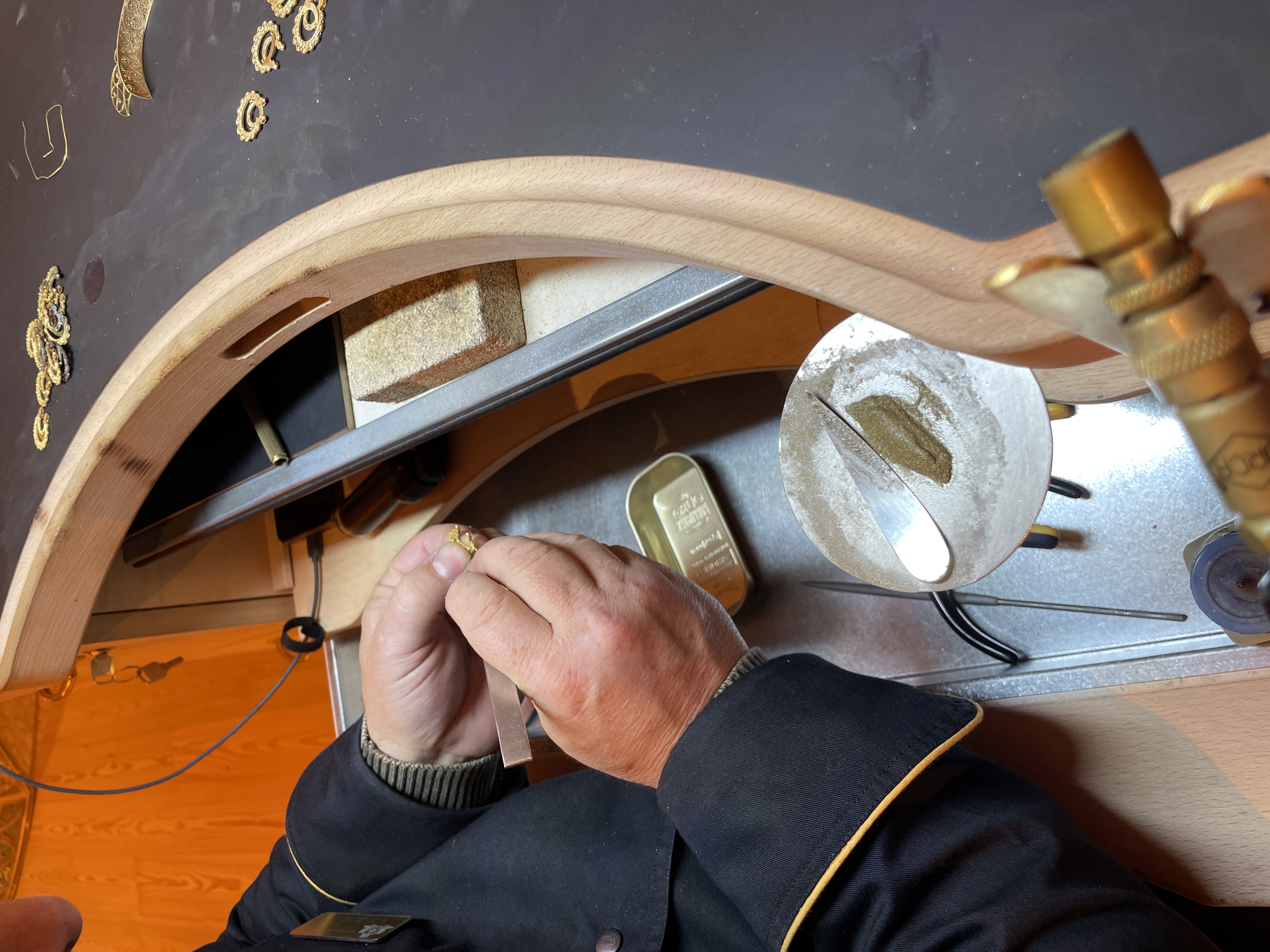
It also houses a museum of Portuguese jewelry art, as well as a classroom where teachers from Cindor, the country's premier jewelry school, conduct seminars and master classes. Portugal's most beautiful jewelry store, Joalharia do Carmo, is also located here.
A spiral staircase adorned with gold filigree leads to the second and third floors of the building. Some elements are already completed and installed. But the work is still ongoing. According to the organizers, it will take 95 years to complete the staircase's decoration.
I am delighted to see the revival of the Golden Street of Jewelers. Just like a gold thread, in the skillful hands of a jeweler, is transformed into a filigree piece of jewelry.
Rua das Flores, one of the city's widest and straightest streets, served to improve trade with neighboring towns. The street was paved in 1542.
Since the land on which Rua das Flores was built belonged to the Cathedral Chapter and the bishop, it was decided that buildings erected there should bear a plaque clearly indicating the land's owner. Thus, the Cathedral Chapter chose to mark its buildings with figures of São Miguel, while Bishop D. Pedro da Costa chose the heraldic symbol of the wheel of Santa Catarina.
Today, these symbols can be found on some buildings.
The opening of Rua das Flores coincided with the end of Porto's privilege, which limited the nobility to city limits. The street became home to noble families, some of whom still survive today.
Rua das Flores was home to the city's most luxurious shops.
The south side of the street was traditionally home to knitwear merchants, tea and coffee shops, and hardware stores.
Jewelers settled on the north side of the street. In the 19th century, the heyday of the jewelry industry, according to various sources, about 40 jewelers (goldsmiths and silversmiths) settled on Rua das Flores.
Because of this number of jewelry workshops and shops, people nicknamed the street Rua das Ourivesarias (Jewelers' Street) or Golden Street.
The 2008 global financial crisis and subsequent pandemic plunged Jewelers' Street into decline. But now the street is gradually regaining its appeal.
In the fall of 2025, a unique center of Portuguese culture opened on Rua das Flores, in buildings 66 to 70. Several renowned Portuguese brands opened their shops and workshops here.
One of these buildings is entirely dedicated to jewelry and filigree. It evokes an Alice in Wonderland atmosphere. Workshops are open here, where curious visitors can observe jewelers at work.
It also houses a museum of Portuguese jewelry art, as well as a classroom where teachers from Cindor, the country's premier jewelry school, conduct seminars and master classes. Portugal's most beautiful jewelry store, Joalharia do Carmo, is also located here.
A spiral staircase adorned with gold filigree leads to the second and third floors of the building. Some elements are already completed and installed. But the work is still ongoing. According to the organizers, it will take 95 years to complete the staircase's decoration.
I am delighted to see the revival of the Golden Street of Jewelers. Just like a gold thread, in the skillful hands of a jeweler, is transformed into a filigree piece of jewelry.
Back to list