 FiligranaPT.pt
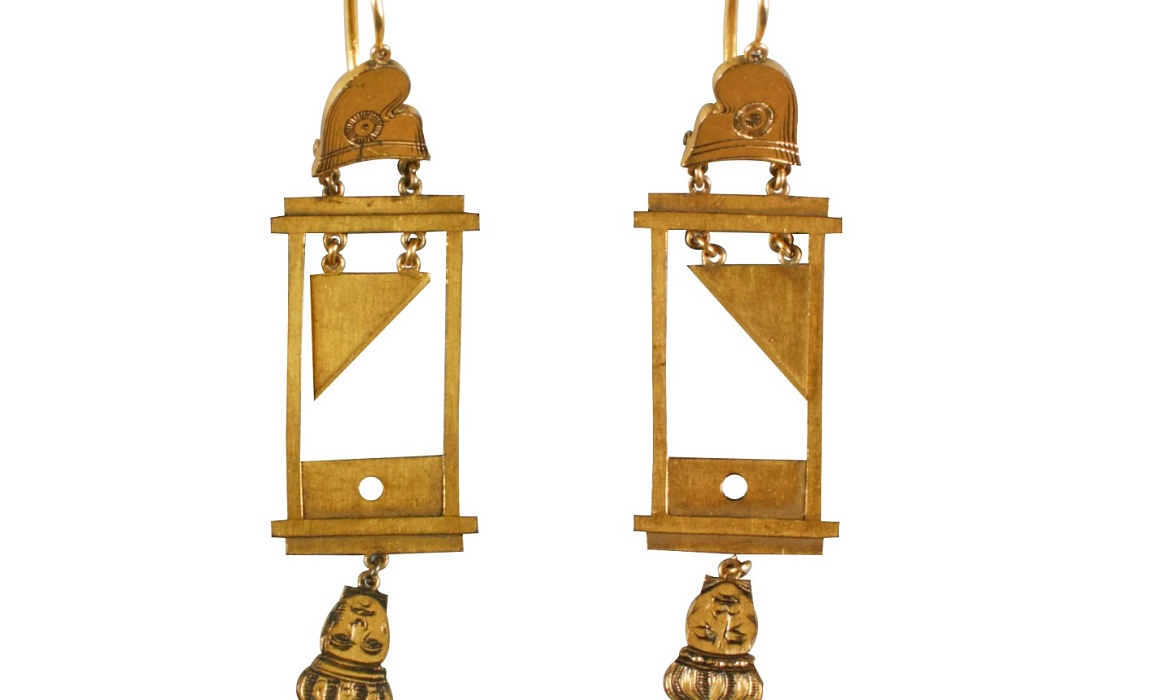
The Reign of Terror in France (*La Terreur*) was a dark and bloody period during the French Revolution, lasting from September 1793 to July 1794.
The official objective of the Terror was to defend the Republic against external enemies and internal traitors. In reality, however, anyone whose behavior, words, or associations suggested "insufficient loyalty" to the new regime could be arrested.
Denunciations became widespread—neighbors informed on one another simply to ensure their own safety—and the guillotine emerged as the primary symbol of revolutionary justice.
It is hardly surprising that French citizens went to great lengths to demonstrate their devotion to the regime.
In his story "The Woman with the Velvet Ribbon," Alexandre Dumas *père* masterfully captures this atmosphere of pervasive fear and paranoia. In the narrative, a dancer named Arsène—with whom the German writer E.T.A. Hoffmann falls in love—wears a velvet ribbon around her neck. The ribbon features a silver clasp shaped like a guillotine, and it conceals a gruesome scar: the mark left by a beheading.
In actual historical life, Parisian fashion went even further: guillotine-shaped earrings became a popular trend.
These ornaments were worn by many; they were crafted from various materials, ranging from gold for the wealthy to copper or brass for ordinary townswomen.
The design of the earrings was detailed and symbolic:
The upper part (which attached to the earlobe) was fashioned as a red Phrygian cap—the primary symbol of liberty and revolution.
Below this was a miniature replica of a guillotine, complete with a movable blade.
At the very bottom, beneath the blade, hung tiny representations of the heads of the executed King Louis XVI and Queen Marie Antoinette.
Today, an original pair of these earrings (dating to around 1793) is held in the collection of the Musée Carnavalet, the Museum of the History of Paris.
Back to list